
Authorship After the Internet
Aarthi Vadde's We the Platform

Over the course of his career, Desiderius Erasmus used twenty-eight different assistants. At the peak of his fame, eight young men, mostly recent college graduates, lived and worked with him. They helped to edit and copy his work, preparing documents for publication. They were crucial to maintaining his vast correspondence—one estimate puts it at 20,000 letters, of which over 1,500 survive. (Sometimes they also brought him his dinner.) Jean Calvin likewise relied on a small army of secretaries to help manage his copious writings and continent-wide religious network. So did many of the other great minds of the European Renaissance and Reformation.
I’ve been reading about these writers’ collaborative working methods in Ann Blair’s new book, In the Scholar’s Workshop: Hidden Histories of Authorship and Collaboration, which I’m reviewing for the Chronicle of Higher Education. The collaborative production of knowledge is, of course, a fact of modern life. The number of authors on articles in JAMA, the Journal of the American Medical Association, has doubled each decade of the new millennium, from ten in 2003 to twenty in 2013 to forty in 2023, dwarfing Erasmus’s mere eight assistants. But Erasmus and Calvin were not contemporary scientists, whose ideas can be detached from their originators. They were authors in the fullest sense of the word: famous figures whose writings were and are interpreted with reference to the person who composed them. Erasmus, in particular, was a pivotal figure in the history of authorship: no one did more to shape the image of the author at the dawn of print than the great Dutch humanist.
Does a better understanding of Erasmus’s use of secretaries undermine his claims to literary authorship? In his case, I don’t think so. But it does make it more interesting. There’s a reason we’re revisiting the question: in the age of AI, there’s a new interest in describing what kinds of literary assistance count as legitimate for authors, and where one kind of intellectual labor shades into another. The debates on this platform that followed Substack’s announcement of a partnership with Pangram to detect AI in posts, and its partial backtracking to allow authors to turn off AI detection, are a good example. But the question of authorship is, in any case, omnipresent and inescapable, exerting an invisible pressure on how we read everything, especially when we read online. On the internet, as Peter Steiner’s famous cartoon put it, nobody knows if you’re a dog—or, for that matter, an author.
The story of the internet’s impact on authors and their writing is the subject of another new book I’ve just read, Aarthi Vadde’s superb We the Platform: How the Internet Changed Twenty-First-Century Literature, just out from Columbia. Aarthi is my colleague and a good friend, so call what follows an engagement rather than a review. Or rather, consider it an example of precisely the phenomenon her book describes: the way writing and ideas now flow from printed books to social media platforms and back again.
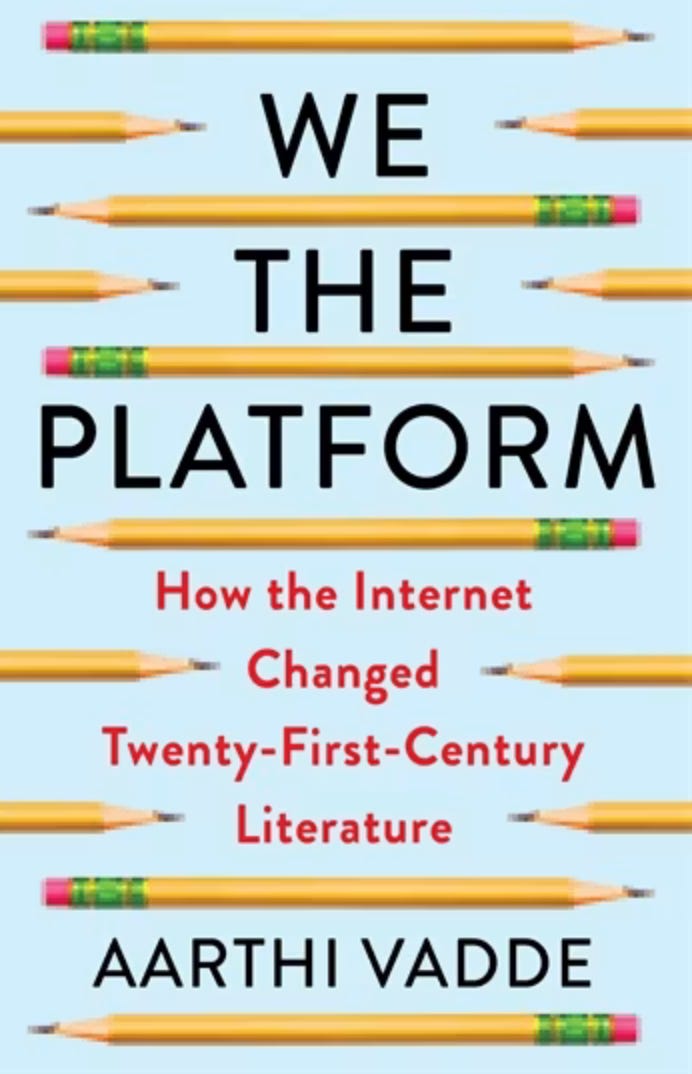
Today, whether we are on the internet or publishing printed books, we write within a world defined by Web 2.0, the transformation of the internet into a platform for sharing user-generated content, from social media to Wikipedia. When literacy was defined by print, there were readers and writers: two groups that overlapped, but could be distinguished. With Web 2.0, everyone is a writer as well as a reader. In fact, many are writers first: we are in an age of “read write literacy,” as Vadde puts it, where younger writers, in particular, no longer think of reading as an activity that precedes publication, but one that occurs in tandem with it. The popularity of creative writing programs, where students approach reading through writing rather than vice versa, is an indication of this attitude. Professional writers, including literary authors, now participate as particular voices within a mass public of writers, rather than as writers approaching a public of readers. “We cannot have literary distinction,” Vadde writes, “without wrestling with the indistinction of mass writing.”
Mass writing on the internet isn’t simply the expression of vox populi. It’s enabled and structured by the architecture of the platforms. Everyone on Substack knows that the fluctuations of the algorithm suddenly change page views and subscriber counts. We see that what seemed in our draft folder to be a unique creation proves, when we click publish, merely a single cell in a complex organism. Up to a point, that’s what it means to publish: to make writing part of a collective culture. But there are collectivities and collectivities. A monastic scriptorium is a very different publishing environment than Twitter, and most literary critics don’t have a very deep understanding of the legal and economic decisions that created the modern internet and its regime of intellectual property.
Vadde’s book is extraordinarily illuminating here. She shows how the Creative Commons movement championed the free reuse of creators’ work, provided it was properly attributed. In other words, authorship entailed recognition—but it didn’t require compensation. This initiative was meant to foster a “remix culture” that would allow amateur creativity to thrive, released from the straitjacket of copyright law. It might have taken as its motto Erasmus’s most famous adage, “between friends, all things are common,” a commonplace whose derivation from a shared intellectual heritage underscored its point. Up to a point, of course, that’s precisely what happened. This treatment of intellectual property became the underpinning of Web 2.0, where authors—now understood to be all of us—could find novel opportunities for recognition, but very limited opportunities for making money. The fruits of their labor went instead to the platforms, which proved to be anything but “commons.” “Authorship is increasingly guided by questions of attribution and evasion in an economy that views literary expression as property but would rather not pay for it,” Vadde writes.
The forms of authorship that have emerged within the Web 2.0 regime are fast becoming the paradigm for all written authorship. The codex retains a certain prestige, but it’s obvious to all of us that the link between literary authorship and the book dissolving. Social media, including Substack, is a place where literary reputations are made, as the career of Lauren Oyler demonstrates. Established literary authors such as Jennifer Egan, David Mitchell, and Teju Cole, whom Vadde discusses in a virtuosic chapter on writers on Twitter, understand this acutely.
And it’s not just writing. Other media, all transmitted through the same glowing screens, are part of the story. Netflix deals follow from success on fan fiction sites such as Wattpad or AO3. Print books are released with Audible versions in mind. The contemporary popularity of multi-character first-person novels not only reflects the multivocality of social media, but the appeal of the celebrity, full-cast audiobook. (Here I’m thinking of Knausgaard’s Morning Star series, which reads to me as an allegory of the internet-as-apocalypse.)
The result is a literary system that puts incredible pressure on authorship, simultaneously affirming and undermining it. On the one hand, the author’s name or handle now connects a whole constellation of writing extending across multiple platforms. As the solid frame of the codex melts into air, only an appeal to the abilities and authenticity of the author can unify and legitimate writing with no single, fixed location, no beginning or end. We need the author’s authority to treat writing as literary, that is to say, as valuable and interpretable. On the other hand, the collective character of mass writing on the internet, where ideas and language are shared and recycled, leads us to view any given writer’s claims to distinctiveness, much less distinction, with (often justified) skepticism. This dynamic, already present with the internet, is extended and accelerated by chatbots.
Vadde is confident that literature, and authorship, can survive this challenge, and her book ends on an optimistic note. “Writers and artists,” she concludes, “will continue to make sense of the computationalized written world.” Ultimately, “literature lives on.” Who can doubt the first of these claims? Artists will, surely, continue to make meaning, and it is valuable to read a study that explains precisely how they are doing so in such acute terms. But though literature, and authorship, lives on in one sense, I’m less sure it will do so in another. If our culture can still make writers, can it also preserve them over time? Has the vertical and temporal dimension of authorship, its ability to cheat death, dissipated even as the horizontal and spatial dimension remains? In five hundred years, will we still be thinking about our own authors and their collaborators? Perhaps—but if so, my suspicion is that it will be due to the world that persists outside the internet.
"We cannot have literary distinction without wrestling with the indistinction of mass writing." This is a very important idea. I think, after reading Byung-Chul Han, that the platform experience we all live with is changing how we experience reality, which in turn is changing literature from the inside.
Useful article and a very tantalizing last sentence! I'd love to hear your thoughts on the world that persists sometime.